Rethinking public trust in science
November 26, 2025
Rethinking public trust in science
Reflections on Global Challenges, by Kaelyn Pacpaco
In his book Sustaining a Free Society: Roles and Responsibilities of Citizens, Leaders, and Schools, Roger Soder—Emeritus faculty member in the College of Education and Honors professor—proposes 15 essential conditions for maintaining a healthy, free society. He begins with the idea of trust. As I sat in this year’s Global Challenges – Interdisciplinary Thinking event, I found myself returning to Professor Soder’s idea again and again.
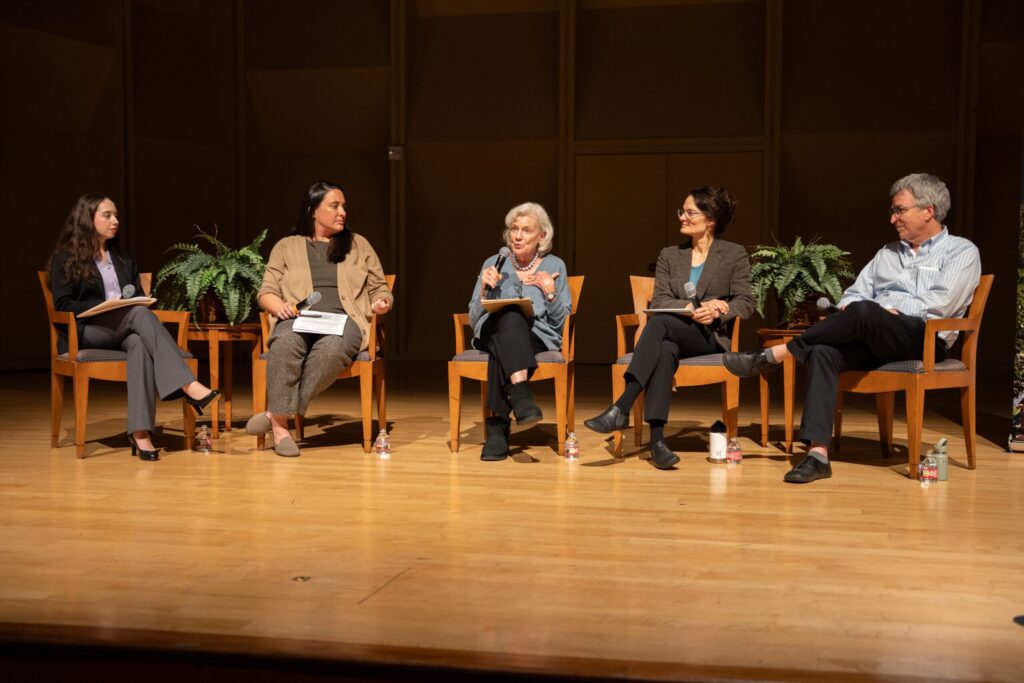
From left to right: Clara McAdams (Interdisciplinary Honors), Dr. Maralyssa Bann (Medicine), K.C. Cole (Physics/Journalism), Dr. Michelle Koutnik (Environment/Glaciology), and Dr. Jon Herron (Biology)
This year, the UW Honors Program centered its 11th annual Global Challenges event on the theme “Public Trust in Science and Why it Matters.” Each year’s topic is chosen by UW Honors students themselves, reflecting complex issues they find urgent and care about most. As a first-year Honors student interested in Public Health, I was immediately drawn to this theme. However, when I think about public trust in science, my instinct is to assume it’s lacking, and that this absence fuels the divide we see today. But this discussion challenged me to rethink that assumption and to consider what trust in science actually looks like. It pushed me to think more critically about what we can do to create a more open conversation around science that feels inclusive, welcoming, and reflective of all backgrounds and perspectives.
“The boundlessness of science can be daunting. Therefore, this often creates a divide between scientists and the people that the science affects.”
Clara McAdams, Moderator & third-year Interdisciplinary Honors student
Moderator Clara McAdams opened the conversation by reflecting on the complexity of science. She shared her own passion “for the brain and the vast amount of wonders it contains,” explaining that “science inherently invites curiosity and exploration because the subject itself is mysterious … Therefore, science also inherently invites skepticism.” The tension between curiosity and skepticism became the perfect entry point into a conversation about what public trust in science really means. And perhaps more importantly, whether science is always something that should be trusted.
As I listened to each speaker, I kept thinking back to what I’ve been learning in Dr. Maralyssa Bann’s Honors course, “Safety-Net Hospitals in the U.S.: Past, Present, and Future.” In the class, we explore how legislation, structural inequities, and historical events have shaped public health outcomes across different communities. During the panel, Dr. Bann emphasized that “we often represent the systems in which we function,” a reminder that our work is never separate from the structures that shape it. As a healthcare provider, she explained her weariness over how her field emphasizes “evidence-based medicine” without always thinking critically about what counts as ‘evidence’. She urged us to ask the deeper question of What assumptions do we make in creating the evidence? For instance, she described how many of her patients live unhoused, face food insecurity, manage multiple comorbidities, or struggle with mental health and substance use. However, these populations are rarely represented in randomized controlled trials, which serve as the gold standard of scientific research. If the evidence excludes entire populations, can we confidently call that science trustworthy?
Another panelist, K.C. Cole expanded on this theme of trust in science, arguing that “it’s not so much the science that causes harm, but the application of it.” With her experience in journalism, she highlighted the danger of sensationalizing science. She provided the example of how research studies often include error bars to represent the uncertainty inherent in science, but media outlets often flatten those nuances into dramatic headlines. Hearing this made me think about how many people, myself included, often encounter science through social media, and how that may not be trustworthy. In fact, strengthening our trust in science requires approaching these sources with critical skepticism.
Takeaways
Walking away from the event, I found myself holding all these perspectives at once. Dr. Michelle Koutnik reminded me that trust in science is possible, and may be more present globally than we might assume. Dr. Jon Herron showed how science can become more meaningful through personal stories. Dr. Bann pushed me to question whose experiences are reflected in the evidence. And Cole called attention to the responsibility we hold as consumers and communicators of scientific information.
Echoing Dean Ed Taylor’s closing remarks, “You say the boundlessness of science can be daunting. But let us all be curious.” This event left me feeling exactly that—daunted, yes, but deeply curious, and more committed than ever to understanding how trust, science, and humanity intersect.
Meet this year’s speakers
K.C. Cole (Physics/Journalism)
Honored for her writing by the American Institute of Physics, Cole is known for her ability to convey complex scientific ideas with a human touch, as in her best-selling book: The Universe and the Teacup: The Mathematics of Truth and Beauty. Currently “senior senior” columnist for popular media outlet, Wired, Cole has developed interdisciplinary courses bridging science, technology and culture at USC, UCLA, and now at the UW. She regularly teaches two popular UW Honors courses: “The Art of Understanding Science” and “The Science of Human Values.”
Maralyssa Bann, M.D. (Medicine)
A hospital-based Internal Medicine physician at Harborview Medical Center and Associate Professor in the Department of Medicine, Dr. Bann focuses on inpatient care rooted in equity, harm reduction, and patient-centeredness. She brings a global and interdisciplinary lens to her Honors course on “Safety-Net Hospitals in the U.S.” and study abroad program “Honors London: Socializing Medicine,” which explores the social, historical, and economic dimensions of healthcare systems around the world.
Dr. Michelle Koutnik (Environment/Glaciology)
A glaciologist whose research focuses on Greenland, Antarctica and Mars, Dr. Koutnik studies how glaciers and ice sheets respond to climate change. She’s been an active part of the UW Honors teaching community for over a decade, bringing planetary science and climate literacy to students through fieldwork-inspired courses and previous Global Challenges panels. Her most recent Honors course in Spring 2025 was “Polar Places and Spaces: Exploring the Greenland Ice Sheet.”
Dr. Jon Herron (Biology)
Dr. Herron, a Teaching Professor in Biology, is the author of Evolutionary Analysis, a widely used textbook now in its 5th edition. He designs virtual biology labs and has taught for UW Honors since 1996, leading courses like “DNA and Evolution” and “Evolution and Human Behavior.” Beloved by students, he’s a multi-year recipient of the Honors Excellence in Teaching Award — recognized for his impressive ability to inspire “non scientists” to embrace scientific discovery and thinking.
Moderator: Clara McAdams (Interdisciplinary Honors Student)
Clara is majoring in Neuroscience with a minor in Bioethics and plans to attend medical school to prepare for her work in pediatric neurology. As a Peer Facilitator, she helps new Honors students learn how to navigate the UW with an interdisciplinary mindset. Clara also leads campus tours, conducts research in the UW Medicine NICU and volunteers with the “Grey Matters” undergraduate neuroscience journal — conducting outreach that makes science more accessible to younger students.
Click here for a more comprehensive list of recommended courses, readings, and opportunities to get involved in science communication at UW!
Winter 2026 Courses
- HONORS 221 A: The Science of Human Values (5 credits) NSc, W. Instructor: K.C. Cole
- HONORS 221 B/C: DNA & Evolution (5) NSc, W. Instructor: John Herron
- HONORS 231 B: Improving Population Health through Social Entrepreneurship (5) SSc, DIV, W. Instructor: Akhtar Badshah
Resources
- Knowable Magazine, an award-winning digital publication from Annual Reviews, which seeks to make scientific knowledge accessible to all. Recommended by GCIT speaker K.C. Cole **
- Grey Matters, a neuroscience outreach organization and quarterly journal founded by students at the University of Washington on the core belief that science education should be accessible to everyone, regardless of educational background. Our Honors student panelist, Clara McAdamas, works with Grey Matters’ Outreach program **
Centers & Projects underway at UW
- Community Engagement and Leadership Education (CELE) Center
- HuSCI (Husky Science Communication Initiative)
Recommended Readings
- Sustaining a Free Society: Roles and Responsibilities of Citizens, Leaders, and Schools by Roger Soder
- Public Trust in Scientists and Views on Their Role in Policymaking by Alec Tyson and Brian Kennedy (Pew Research Center)