Writer and Encourager Rachel Sobel Wins HETA
May 14, 2025
Writer and Encourager Rachel Sobel Wins HETA

After reading through all of the wonderful nominations, we are thrilled to announce that the 2024-2025 Honors Excellence in Teaching Award (HETA) goes to Rachel Sobel!
This award is determined entirely by quantity and strength of nominations from students enrolled in Interdisciplinary or Departmental Honors at the UW.
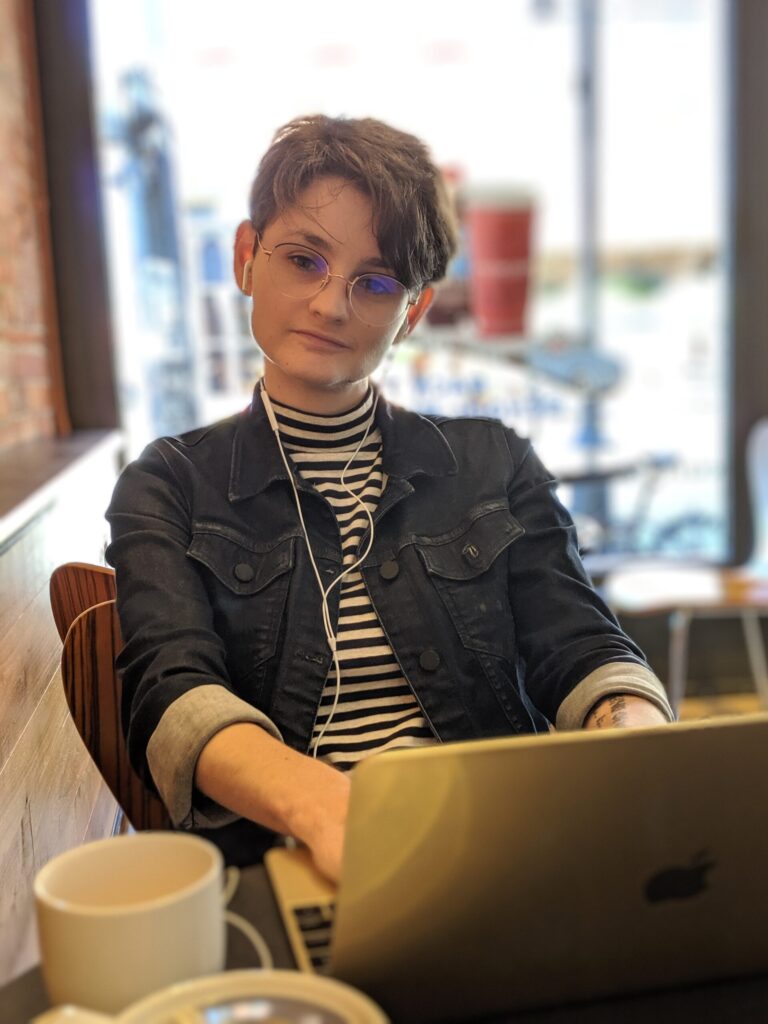
Rachel Sobel writes speculative and literary fiction about dykes and other queer people. She teaches computer ethics in the Allen School and creative writing in the Honors Program, and is a founder of the local publisher Homeward Books.
Rachel Sobel will be teaching her popular Honors course “Writing Speculative Fiction from Life and Research” in Autumn 2025. This course motivated students to nominate her for this year’s award.
Select Excerpts from Nominations
“Rachel fostered a classroom community and environment for discussion that was magnificently welcoming, engaging, and earnest. Her passion for fiction and writing shone through in her teaching, and she managed to bring knowledge to students in a way that really makes one appreciate, and more importantly, believe the interconnection between art and broader life. The care she demonstrated in her teaching and assignment crafting made me feel like there was never a minute in the classroom, a word written, or a lengthy essay read that was unnecessary or “busy work”. She supported an environment that made our work and contributions feel meaningful and valued. Everything about her class was meaningful, and I will be doing my best to carry some of that meaning with me as I navigate whatever is happening in the world.”
“Professor Sobel (or Rachel, as she asked us to call her) provided such a uniquely, wonderfully creative space for us to grow as writers. She went consistently above and beyond with her dedication to the class. It felt so wonderful to have someone who was so genuinely interested in all of our ideas and our writing. No matter how seemingly silly or half-baked to the idea, she always treated it with respect and offered genuine guidance on how we could develop our stories. Going to her office hours always felt like a magical process where I came in a little lost and a little confused and came out feeling like I had somehow invented something new.”
Q&A with Rachel Sobel
Honors: What do you love most about teaching Honors students?
Sobel: I love hearing about all the different things my students are working on–whether that’s personal projects, research, TAing, or student organizations. Because my speculative fiction course is focused on a very nonstandard type of research, we often get the chance to dig deep into the special interests of individual students. One of my favorite in-class activities is asking people to interview each other about a specific skill. To be able to write well about something, you need to know not just the academic facts, but also the experiential ones. What’s it like to be really good at this? What kind of jokes do people in this field tell? What kind of actions are dangerous, or annoying, or secretly fun?
Honors: How would you describe your field of research and study?
Sobel: I’m most centered in the world of fiction–I write novels, I teach classes at the lovely local institution Hugo House (as well as my UW classes), and I’m the main editor for a genre-defying small press, Homeward Books. My fiction ranges from the fantastical to the very grounded, but it’s always about the reality of queer experience. I often push my students to tell me what things are really like–to observe their own experience, in other words–and it’s my hope that my fiction achieves this aim. I’m interested, too, in questions of what societies are really like, and that’s what draws me to the world of speculative fiction: it’s a chance to think critically about really big questions of how our lives are organized and what it would mean to change the systems that surround us.
Honors: Did you always know you wanted to be a professor?
Sobel: Not at all! In fact, I’m still not totally sure I’m a professor. I’ve always been a writer, and that’s still the central thing for me, but I was very shy when I was young, and struggled to talk to anyone–professors, advisors, fellow students, etc. I think my parents still find it surprising that I talk to big groups of people for a living! That said, it’s amazing to be at a university. I’m constantly exposed to amazing ideas, I get to meet amazing people, and I spend most of my class time talking over big ideas. What could be better?
Honors: What was a moment or class in college that shaped who you are today?
Sobel: I started out as a biology major, and when I’m teaching, I think a lot about two great biology classes: Experimental Ecology and Evolution (taught by a trio of great faculty), and Dee Boersma’s Field Ecology course. In both cases, the faculty treated us like real scientists, setting us up to ask our own questions and holding us to the same standards they’d look for in their peers. There’s a temptation when you’re doing lab experiments to describe your results in a way that makes them look more interesting, and it’s really hard to step back and say what your data actually shows. So there are two lessons there: first, the value of being really rigorous and careful–and second, the value of treating your students like real intellectuals who can make a genuine contribution to the world with their work.
Honors: What is an interdisciplinary approach/lifestyle you see in your own life (whether that be hobbies, work, research, or something else)?
Sobel: I’m not sure how to answer this one, because writing fiction is such an inherently interdisciplinary discipline that it permeates my whole life! In terms of teaching, I’m lucky enough to be able to mix and match: I teach creative writing classes, and I also teach in the Allen School–mostly computer ethics (CSE 480, which is a great class), but I’ve also taught a bunch of intro courses, where I love the “aha!” moments that come with introducing students to a totally new way of thinking. In college, I minored in history and came really close to getting a biology degree as well as the CSE degree I actually have, and my grad degree is in creative writing. Essentially, I’m incurably nosy and want to ask everyone questions about everything all the time–that’s a very specific flavor of interdisciplinary, but one that’s common to a lot of novelists, I think!
Please join us in congratulating Professor Sobel. We are thrilled to have her in the UW Honors community!