28 Honors students named to the 2026 Husky 100
April 20, 2026
28 Honors students named to the 2026 Husky 100
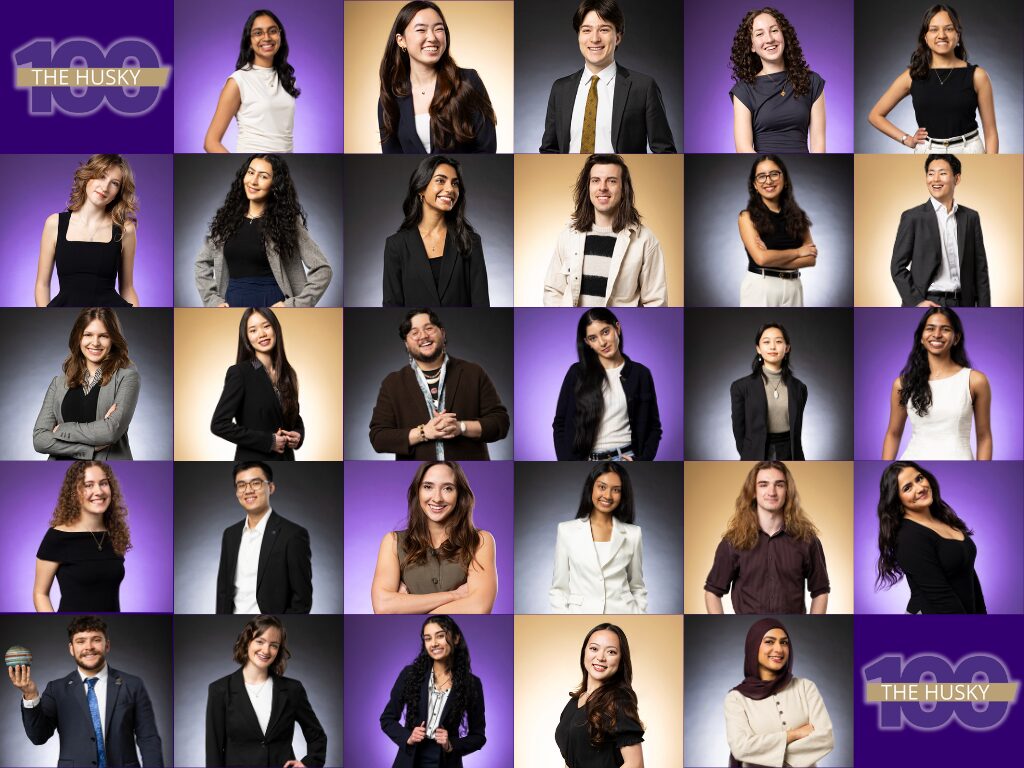
Each year, the University of Washington recognizes 100 students whose academic journeys demonstrate personal growth and transformation. These students actively engage with their communities, lead with purpose, and take on complex, often ambiguous challenges. From volunteering at a community food forest to contributing to NASA’s LISA mission, these Honors Huskies are applying what they learned to make an impact across their UW experience.
This year, the following 28 students from the Honors Program were named to the 2026 Husky 100:
- Alex Ross
- Andrew Shaw
- Anika Neumeyer
- Anya Higashionna
- Aybala Turkarslan
- Clara Kreutziger
- Cordy Plymale
- Ethan Hynes
- Hunter Jung
- Junseo Park
- Krisha Khandelwal
- Leslie Cheng
- Lorin O’Leary Stephens
- Maya Falodia
- Mckinley Smith
- Michelle Echeverria Aguilar
- Nidhi Ashani
- Rachel Cameron
- Renee Zhang
- Sahana Subramanian
- Santino Camacho
- Sarah Desai
- Sarrah Khan
- Shivani Kottantharayil
- Shivani Jayaprakasam
- Silas Healy
- Sonali Agarwal
- Sophie Biernacki

Maya Falodia ’27 is pursuing a Bachelor of Science in Computer Science with a minor in Disability Studies. As part of the Honors Program, she was a Peer Facilitator, helped with the Honors Peer Mentoring Program, worked as a recruitment ambassador, and now is a Student Assistant. She also serves as Vice Chair of Minorities in Technology. Maya has conducted research with the Taskar Center for Accessible Technology in the Allen School and is currently conducting research on Open Source Projects related to accessibility in the Make4All Lab. She also went on a study abroad in Rome, Italy, where she analyzed the access and inclusion of Rome and its transit systems.
Anika Neumeyer ’27 is pursuing a Bachelor of Arts in English and Law, Societies, and Justice. She has been involved with the Interdisciplinary Honors Program as a Communications Intern, Peer Facilitator, and Student Assistant. Beyond Honors, Anika serves on the Executive Board of UW Dawg Pack and works as a social media intern at the University Book Store. She also led a book drive in collaboration with UW Athletics and studied abroad with the LSJ Amsterdam program, where she studied public school segregation in Seattle and Amsterdam.

Q&A with Maya and Anika
What does being recognized as a Husky 100 mean to you personally?
Maya: I feel grateful to be recognized and proud. Husky 100 is a goal I set for myself my first year after I saw friends and mentors I really looked up to get recognized as Husky 100. To me, Husky 100 represents students who are using their education and skills to make the world around them a better place, which is what I’m trying to do! I was excited when I found out I achieved my goal of being part of Husky 100.
Anika: This award helps me feel more confident in my goals to tackle literacy, censorship, and educational policy—topics which I often feel are side-lined. It also means that my work and efforts toward these topics/interests/areas have been recognized at UW. This award doesn’t only recognize myself, but also all the communities and programs I am connected to here at the UW that have made it possible for me to achieve this. I am proud that I can represent them with this award.
Reflecting on your time at UW, is there a moment, experience, or activity that reshaped how you see yourself or your future? What did you take away from it?
Maya: One important moment of my time at UW was related to being a peer facilitator. As a peer facilitator, I had to put together a panel of current and alum Honors students for my Honors 100 section. One of the panelists was a UW alum, who majored in Disability Studies. After the panel, I talked with her a bit, as I was really interested in Disability Studies but didn’t know a lot about the program. I set up a coffee chat with her, where I learned more about her path and classes she recommended. It is partly because of her I am minoring in Disability Studies and why I went on the specific study abroad I did. This experience showed me how new connections can come from anywhere and anyone, and that I wanted to pursue Disability Studies.
Anika: One of the most vital experiences to my time at UW was the Communications Internship with the UW Honors Program. Looking back, this role really gave me the first stepping stone at UW and helped me immerse myself in a program that would guide my time here. Everything I have accomplished at UW stemmed from that first role in Honors: whether it was the development of a digital portfolio that landed me a Social Media internship at University Book Store, my mentor’s encouragement to study abroad with LSJ, or the Community Spotlights student interviews motivating me to create my own Mary Gates Leadership project.
In what ways has UW prepared you for what’s next, and how do you hope to carry those experiences forward?
Maya: UW has offered me so many experiences, from research to studying abroad to leadership roles. All of these experiences have helped me develop and gain skills like public speaking, project management, being adaptable, and strong technical knowledge. A lot of my experiences are linked by the common threads of proactive inclusion and accessibility. I hope to carry these guiding principles forward in whatever I do next. After graduation, I plan to work as a software engineer, with hopes that I can bring my skillset from minoring in Disability Studies and doing research in accessible technology into the tech world. I’m going back to Disney for my second internship this summer, so I could see myself returning to Disney full time. However, I am also interested in working at non-profit organizations or doing research related to accessibility in industry.
Anika: My time at UW has really opened my eyes to the opportunities that arise when you approach things with an open interdisciplinary mindset. I really found my path here at UW when I began drawing things from both my English and LSJ courses and thinking about how they could work together, whether in assignments or larger extracurricular projects. My experiences here have taught me to believe in the conviction of my ideas and my own ability to achieve them. Moving forward, I will take this belief and interdisciplinary mindset with me in my future pursuits and goals. After graduation, I plan to pursue an M.A. in English Literature before moving onto law school. I want to eventually serve as a First Amendment lawyer to fight book bans and censorship.
What advice would you give to the next generation of Honors students?
Maya: Always be open to new opportunities and new connections! You never know when a new classmate, friend, or mentor will connect you to your next passion or interest. I think it’s important to try new things and experiences to figure out what you want to do, and it will often take a lot of experiences to figure out what that is (I’m still figuring it out). While it’s important to be open to opportunities and connections and to say yes to them, remember to take care of yourself and take time to rest.
Anika: I would say to try everything that you can or are interested in because there isn’t anything to lose if you don’t get a club leadership position or onto a certain research project. Don’t be afraid to ask people for help or support if you have an idea. You never know when you might surprise yourself and get an opportunity that perhaps you might’ve scared yourself off of if you hadn’t put yourself out there.